

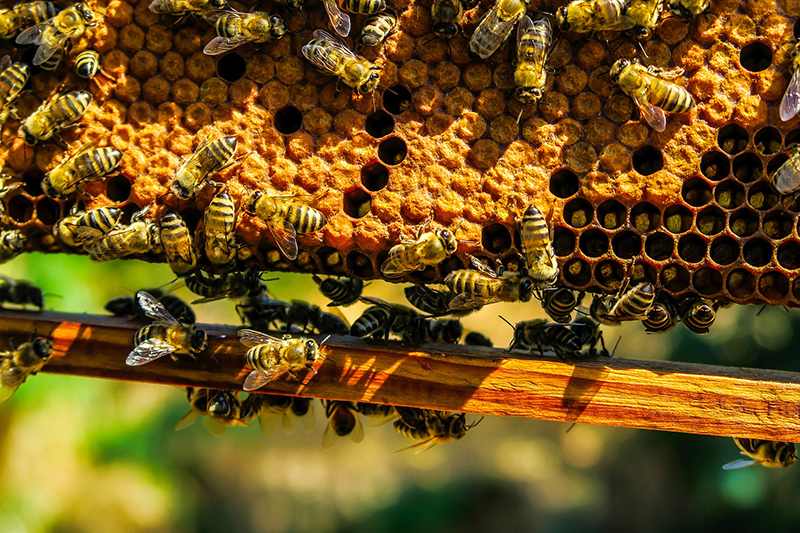
Beekeeping is a completely safe activity in residential areas with good management practices and provides valuable educational and recreational opportunities for people to connect to nature and to our food system.
Effective May 19, 2026 residential and commercial/multi-unit beekeepers are required to obtain an urban livestock licence. In Edmonton, keeping urban bees is controlled and enforced under the Animal Care and Control Bylaw.
Note: Before you apply or invest in bees and equipment, the intention of the program is to support urban beekeeping as a hobby and non-commercial activity.
Beekeeping Licence
Apply online for your residential beekeeping licence.
Pre-Application Requirements
Neighbourhood Notification
Prior to submitting an application, every beekeeping applicant must notify all immediately surrounding neighbours, including those attached to their property or across an alleyway, in writing, of their intent to keep bees. In the case where neighbouring properties are apartment buildings or businesses, building managers and business owners are to receive the notification letter.
- This requirement is a notification to neighbours, not a request for permission
- Your neighbours have 2 weeks to respond to the City of Edmonton with any concerns after receiving the letter.
Do not submit your online application until you have given your neighbours 2 weeks to respond to the letter from the date it was sent.
If you do not submit all required notification letters as a part of your online application, those who did not receive the letter will be given another 2 weeks to respond so double-check that you have notified all the required properties.
Neighbourhood Notification Letter Template
Please note the date and addresses on copies of the letters that are given out in your application.
We do not require that the letters be signed, however, copies of the letters you send with the date and address indicated on the letter need to be submitted with your online application.
Application Requirements and Process
Step 1: Review the City’s Beekeeping Guidelines
The Urban Beekeeping Guidelines help residents understand the expectations that the City has for beekeepers. Interested beekeepers will also benefit from connecting with the beekeeping community and talking to existing beekeepers to learn more about what it takes to keep bees in the city.
- Hives must only be located in the rear yard of a property
- Sites must be located at least 25 metres away from any public place, including but not limited to playgrounds, sports fields, churches or schools
- Hive entrances must be directed away from adjacent residential properties
- Hives should be located at least 3 metres from all property lines where there is an adjacent neighbour, unless the property is separated from the adjacent neighbour by a solid fence or vegetative hedge at least 1.5 metres high
- Each approved property shall house one active hive consisting of a bottom board and hive cover with a maximum of 6 supers
- Each Site may keep a nucleus (Nuc) hive to provide options for good animal husbandry and hive management
- Applicants who have been keeping bees for at least 2 years in good standing may apply for a second hive by submitting a revised site plan indicating the placement of the additional hive through 311
Each approved beekeeper and the property owner and/or a resident of the site must complete a beekeeping course from an accepted organization/association.
Beekeepers in their first year are recommended to have the support and assistance of an experienced beekeeper.
Every beekeeper shall adhere to good management and husbandry practices and maintain bees in such a condition so as to prevent swarming, aggressive behaviours and disease. Animal Control must be notified of any swarms and/or disease and the steps taken to rectify the issue.
Approved beekeeping site owners shall make themselves and the hive(s) available for inspection on the reasonable request of Animal Control Peace Officers.
Should Animal Control Peace Officers find a site, hive or beekeeper to be unsuitable at any time, the permission may be revoked and the site owner must relocate the hive and bees to a location outside the City of Edmonton. All costs and associated expenditures related to the removal are the sole responsibility of the site or property owner. Permission can be revoked due to documentation of medical concerns from residents of neighbouring properties.
Step 2: Register with Alberta’s Premises Identification Program (PID)
As part of the Animal Health Act, owners of bees must have a premises identification account and premises identification number for the bees. This requirement is a part of a traceability system designed to address potential threats of disease outbreaks that could affect animal health, public health and food safety.
Step 3: Apply for a Beekeeping Licence
All interested beekeepers must submit an online application outlining the following requirements:
- Name, address, and contact information for site owner (if you are not the owner of the property on which you plan to keep bees, include a signed letter of permission from the property owner)
- Confirmation of location of hive in relation to the property (site drawing or photo evidence of compliance with setback requirements)
- Proof of success in an accepted beekeeping course
- Beekeepers in their first year are recommended to have the support and assistance of an experienced beekeeper
- Proof (and date) that all immediately surrounding neighbours, including those separated by an alleyway, have been informed of the applicant’s intention to keep bees on site
- Your PID number
Step 4: Register with the Provincial Apiculturist
As a part of the Bee Act and Regulation, beekeepers must register with the Provincial Apiculturist every year by June 30.
Training Courses
Individuals can take any of these intensive beginner courses offered by City-approved organizations and associations to receive a beekeeping certificate.
| Institution | Course Name | Delivery |
|---|---|---|
| Northern Alberta Institute of Technology (NAIT) | BEKP100 - Level 1 Beekeeping | Virtual/Online |
| BeeComm - The Bee Community | BeeComm | Virtual/Online |
| Natural Elements Honey | Beekeeping for Beginners | In-person |
Complaints Process and Enforcement
Animal Control Peace Officers will respond to all complaints and initiate investigations when warranted.
- Failing to comply with the terms and conditions of an urban lvestock licence may result in a fine of $100, or a licence being revoked
- Keeping bees without a licence will result in a $250 fine
All public complaints shall be directed through 311. This reporting approach is consistent with the City of Edmonton bylaw complaint process.
Applying for a Second Hive
Applicants who have been in good standing in the program for at least 2 years may apply to have a second hive.
Applicants who wish to have a second hive can inquire through 311 with a revised site plan indicating the placement of their proposed hive.
What To Do About Swarms
A swarm of honey bees is not dangerous. Swarms typically occur when about half of the bees in a colony leave with the queen to form a new colony. Swarming is the natural means of reproduction for honey bee colonies.
In the event that a honey bee swarm lands on your property, call 311 to inform the City.
Contact Us
Animal Care & Control Centre
Phone 311 | Outside Edmonton: 780-442-5311
Fax 780-496-8824
Address 13550 - 163 Street Edmonton, AB