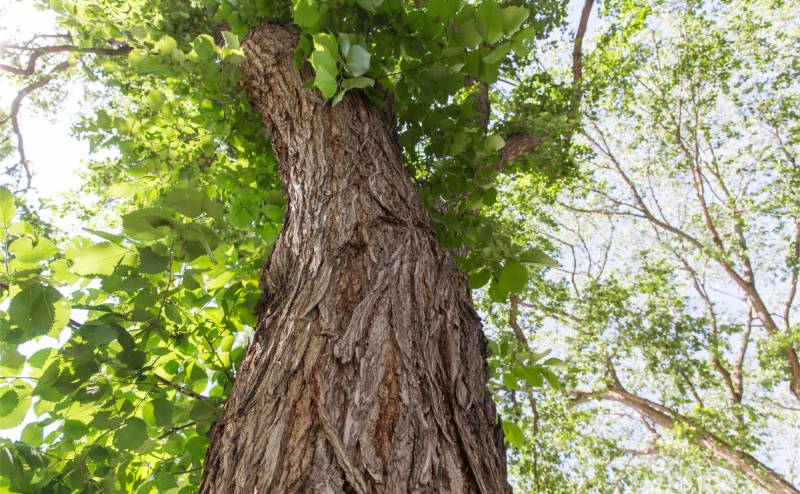
Dutch elm disease (DED) was first confirmed in Edmonton in 2024. The City continues to follow a coordinated management plan to respond to and contain the spread of the disease.
Pruning of Elm Trees
Under Edmonton's Community Standards Bylaw 14600, pruning elm trees is illegal between April 1-September 30 each year.
A total of 7 cases of Dutch elm disease have been identified in the city. The City of Edmonton continues to follow an integrated response in coordination with the Canadian Food Inspection Agency (CFIA), Alberta’s Ministry of Agriculture and Irrigation and the Society to Prevent Dutch Elm Disease (STOPDED).
Dutch elm disease is a deadly disease caused by a fungus (Ophiostoma ulmi) that can affect any elm tree. Since its introduction from Europe in about 1930, it has destroyed millions of American elm trees across North America. The disease is spread through tree roots and beetles which can transport the fungus to other nearby trees.
The City activated an action plan in 2024 to respond to and reduce the risk of spreading DED. The plan includes ongoing inspections, assessments and testing of all elms in the vicinity of the infected area.
The City conducts targeted elm tree removals to reduce the habitat of the beetles that spread the fungus. City-owned elm trees with significant leaf death at the top of the tree, small elm trees and elm trees in unsuitable growing locations, such as alleys, are considered for immediate removal.
On Private Property
The property owner is responsible for the cost of maintaining and removing infected elm trees on their property. Under the Agricultural Pests Act, property owners are required to not have a habitat for listed plant pests, including the banded elm bark beetle.
Keep Track of Elm Trees
Watch for these symptoms of Dutch elm disease:
- Drooping and yellowing leaves in summer
- Branches with smaller leaves than the rest of the tree
- Branches with no leaves
- Brown wilted leaves that remain on the tree
Monitor the condition of the elm trees in your neighbourhood. If you suspect Dutch elm disease on any public or private elm tree, please call 311 or report them online.
If you need help with pruning, contact a professional arborist certified by the International Society of Arboriculture (ISA).
Prune and Dispose of Elm Wood
Pruning dead and dying branches on healthy elm trees is only permitted from October 1 to March 31. If you notice dead elm branches during the summer, plan to remove them once the pruning ban is lifted in October.
Elms that suffer major injury such as a lightning strike or storm damage during the summer may be pruned, but branches must be chipped, burned or buried promptly. A City inspector may also approve limited clearance pruning to mitigate electrical hazards or to avoid construction damage.
Written permission must be obtained prior to any elm pruning performed during the elm pruning ban from April 1 to September 30, by contacting the City at 311 or reporting online.
Elm stumps should be de-barked or ground to a depth of 10 centimetres (4 inches) below soil level.
All elm wood must be properly disposed of at the Edmonton Waste Management Centre (EWMC) and must not be stored under any circumstances or kept as firewood. Residential disposal at EWMC is free. Fees apply for commercial disposal.
- Do not combine elm wood with food scraps, yard waste or other collected waste
- Do not take elm wood to the Eco Station
Transporting Firewood from other Jurisdictions
If you go camping or travel, do not transport firewood. Beetles that carry DED are most often transported to Edmonton through firewood, so always “burn it where you buy it.”
Possessing or storing elm wood in Edmonton is prohibited under provincial and municipal regulations.
Identifying an Elm Tree
Elm trees can be identified by their alternating branching and leaf pattern, serrated leaf edges and shape of their thin, flat seeds called samara.
Symptoms of Dutch Elm Disease
- From the latter half of June to the middle of July, the leaves on one or more branches may wilt, droop and curl. The leaves then turn brown and usually remain on the tree.
- If the tree is infected later in the summer, the leaves will droop, turn yellow and drop prematurely. Late-season infections are easily confused with normal seasonal changes.
- Brown staining in the sapwood, which can be seen by removing the bark of infected twigs if there is wilt on the tree.
- Beetle emergence holes, the size of the diameter of a pencil lead, and/or sawdust on the bark, indicate burrowing beetles.
Since other diseases like Dothiorella Elm Wilt can cause symptoms similar to those of DED, positive identification requires a laboratory test.
Dutch elm disease is spread by bark beetles that are 3.5 millimeters (⅛ inch) long. The beetles breed in dead or pruned elm wood and carry fungal spores to healthy trees.
Signs of Bark Beetle Activity:
- Tiny beetle emergence holes, about the size of the diameter of pencil lead
- Sawdust on the bark or base of the tree
- Breeding galleries on the surface of the wood under the bark
Beetles burrow under the bark to feed or breed and leave behind fungus spores that plug the tree’s water-conducting tissues. This causes branches to wilt and die within one or two seasons.
Online Reporting
You can submit a report to 311 for sick, dead, overgrown or damaged trees on public property.
Report a Dead Tree
To report a dead tree on public property, please call 311.
Frequently Asked Questions
You must remove the tree immediately to stop the spread of the fungus. Under the Agricultural Pests Act (APA), Pest and Nuisance Control Regulation, all municipalities, counties and MDs in the province of Alberta have the responsibility and authority to prevent and control Dutch elm disease. The City has the authority to test private trees.
If a test is positive, you will receive a formal notice to remove the tree within 10 days. The City may issue a Notice to Remove if property owners fail to comply within the prescribed timeline to remove a tree that has tested positive for Dutch elm disease.
The City utilizes 2 products for City elm trees. Both products are injected directly into the tree and safe for people and animals.
TreeAzin Systemic Insecticide
TreeAzin Systemic Insecticide is used to treat trees with European elm scales. This insecticide reduces the numbers of elm scales and red elm weevils to help the tree fight off the banded elm bark beetle, which is known to spread the Dutch elm disease fungus. This chemical does not adversely affect any organism other than the insects underneath the tree bark.
Arbortect 20-S Fungicide
Arbotect 20-S is the industry standard fungicide for the prevention of Dutch elm disease. It requires ongoing treatment every two to three years for the continued life of the tree. It can only be used on trees of a specific size, age and condition. It is being considered for use in high-value City-owned trees which meet all the specifications and to treat non-infected elm trees within the DED Protocol Zone.
The City recommends contacting an ISA Certified Arborist to assess your private elm tree. An arborist can help you determine if your tree is a candidate for Arbotect 20-S based on tree size, age and condition, and can provide an estimate.
At this time, the City does not recommend fungicide inoculation for trees outside a Dutch elm disease Protocol Zone because the risk is low. Injections require drilling multiple holes into the tree every 2 years, which can impact the tree’s long-term health.
No. The City only treats select high-value City-owned elm trees which meet all the specifications (size, age and condition) and are on public property within specific Protocol Zones near known Dutch Elm disease cases.
Elm trees are not generally found in the river valley. The City has developed mitigation efforts to prevent other risk factors for trees in the valley, such as increased wildfire risk and routine monitoring for other potential diseases trees in the river valley may be susceptible to.
To date, there are no identified cases of Dutch elm disease in the river valley or other areas of Edmonton.
The City maintains a comprehensive inventory of over 400,000 open space and boulevard trees on City-owned property. Each year, landscape technicians evaluate the condition of all boulevard and open-space trees in the City’s inventory.
Trees are marked for removal when their condition is graded at 15% or less. Trees with a condition of 15% or less may be in decline or dead for several reasons including age, damage, insect or disease issues and stress from drought. The City of Edmonton has a Tree Replacement planting program to replace trees that have been removed.
Any trees showing suspected signs or symptoms are being tested to determine if they are infected. Under the Agricultural Pests Act (APA), City inspectors have the authority to compel property owners to take any action that may be necessary to prevent the establishment or spread of Dutch elm disease, including pruning or removal of trees or deadwood. This would remove the habitat for beetles that spread the disease. The APA also requires property owners to prevent, control or destroy any pest on their property, including the banded elm bark beetle, which spreads Dutch elm disease.
If City inspectors suspect a symptomatic elm tree on private property, they may gather samples for laboratory testing. The APA grants City inspectors the authority to enter private property to gather samples to test for Dutch elm disease. As a courtesy, City inspectors attempt to contact the resident at the front door before entering the property for brief tree inspections.
For any private tree testing positive or otherwise suspected of being infected by Dutch elm disease, the resident will be notified as soon as possible with a subsequent notice, issued pursuant to the APA, which will provide further direction as to what steps need to be taken related to the tree(s). The resident must comply with the Notice, which will provide direction for tree removal and stump grinding. Removal of trees on private property is the responsibility of the property owners.
Elm trees are not native to our region, but since being introduced through horticultural planting they have played an important role in our city’s urban forest.
The City had previously reduced the number of elms being planted through our replacement planting programs. Annually, the goal is to plant no more than 15% of replacement trees as elm (this equates to less than 900 trees annually). Our target is to only use elm in replacement planting locations with harsh growing conditions, like hardscape or arterial boulevard road sites, where other species have not shown survival rates as high as elm.
Elms are still being planted through capital and developer projects. During design review, species diversity is encouraged to reduce the percent of any given species on a site or in the landscape.
The City has an integrated response in coordination with the Canadian Food Inspection Agency, the Alberta Ministry of Agriculture and Irrigation and the Society to Prevent Dutch Elm Disease (STOPDED). Samples from trees are immediately submitted to the Alberta Plant Health Lab at the Ministry of Agriculture and Irrigation. The City continues to work with the Alberta Plant Health Lab to test symptomatic and high-risk trees in the area. Removals and disposals of infected trees are closely coordinated with the CFIA.
The City continues an enhanced surveillance program which includes city-wide neighbourhood elm surveys, elm bark beetle trapping and increased monitoring. Traps for the elm bark beetles were increased in 2024 following the first positive case of Dutch elm disease in Edmonton. These traps are visible throughout Edmonton.
The traps allow us to monitor the movement of the beetles in the area. The banded elm bark beetle is suspected to have spread the DED fungus between trees. The beetle lives under the bark of elm trees but has also been found in willow and caragana. Since its first detection of low numbers of beetles in Canada in 2008, the beetle has grown to outnumber the smaller European elm bark beetle in Alberta. In eastern Canada and the US, the major vector of Dutch elm disease is a different species, the native elm bark beetle, which has never been found in Alberta.
The following regulations apply to public and private trees in Edmonton:
Canada: Under Canada’s Plant Protection Act, Plant Protection Regulations, the movement of both Dutch elm disease (DED) pathogens is regulated. Elms from a DED-infected province cannot be shipped to a disease-free province. Alberta and British Columbia are classified as DED-free.
Alberta: Under the Agricultural Pests Act (APA), Pest and Nuisance Control Regulation (PNCR), both DED pathogens (Ophiostoma ulmi and Ophiostoma nova ulmi) – and the European and native elm bark beetles that carry them – are named declared pests in Alberta.
Under the Act and Regulation, all municipalities, counties and MDs in the province of Alberta have the responsibility and authority to prevent and control DED.
Under the APA, residents can be fined $5,000 for non-compliance to the act.
Some City staff have been appointed as inspectors under the province’s Agricultural Pests Act. Under the provincial legislation, inspectors can enter onto private property to inspect for elm firewood, if they suspect, or have reason to believe, someone is storing elm wood. Inspectors do not inspect inside homes, garages or sheds, and they only observe external spaces that are accessible to them.
Contact Us
Pest Management
Phone 311 | Outside Edmonton: 780-442-5311 | TTY: 780-944-5555


